

3x 18 What Is X
| | This article needs to exist updated. (October 2021) |


Illustration of Hypersonic Test Vehicle (HTV) 2 reentry phase
The DARPA Falcon Project (Force Application and Launch from Continental Us) is a two-role articulation projection between the Defence force Avant-garde Enquiry Projects Agency (DARPA) and the United States Air Force (USAF) and is office of Prompt Global Strike.[i] Ane part of the programme aims to develop a reusable, rapid-strike Hypersonic Weapon System (HWS), now retitled the Hypersonic Cruise Vehicle (HCV), and the other is for the development of a launch system capable of accelerating an HCV to cruise speeds, too every bit launching pocket-sized satellites into Earth orbit. This two-part plan was announced in 2003 and connected into 2006.[2]
Blackswift was a project appear under the Falcon imprint using a fighter-sized unmanned aircraft which would take off from a runway and accelerate to Mach half dozen (7,400 km/h; four,600 mph) before completing its mission and landing again. The memo of understanding (MoU) betwixt DARPA and the USAF on Blackswift—also known every bit the HTV-3X—was signed in September 2007. The Blackswift HTV-3X did not receive needed funding and was canceled in October 2008.[3]
Current research under FALCON plan is centered on Ten-41 Common Aero Vehicle (CAV), a common aeriform platform for hypersonic ICBMs and cruise missiles, likewise as civilian RLVs and ELVs. The epitome Hypersonic Technology Vehicle 2 (HTV-2) start flew on 22 Apr 2010; the 2d test flew eleven August 2011 reaching Mach twenty. Both flights ended prematurely.[4] [v]
Blueprint and development [edit]
By projects [edit]
The aim was always to be able to deploy a craft from the continental United States, which could reach anywhere on the planet within one to ii hours. The 10-20 Dyna-Soar in 1957 was the starting time publicly acknowledged program—although this would have been launched vertically on a rocket so glided dorsum to Earth, every bit the Space Shuttle did, rather than taking off from a track. Originally, the Shuttle was envisaged as a part-USAF functioning, and separate military launch facilities were congenital at Vandenberg AFB at dandy cost, though never used. After the open DynaSoar USAF programme from 1957 to 1963, spaceplanes went black (became highly classified). In the mid-1960s, the CIA began work on a loftier-Mach spyplane called Project Isinglass. This developed into Rheinberry, a design for a Mach-17 air-launched reconnaissance shipping, which was later on canceled.[six]
According to Henry F. Cooper, who was the Director of the Strategic Defence force Initiative ("Star Wars") under President Reagan, spaceplane projects consumed $4 billion of funding in the 1970s, 1980s and 1990s (excluding the Space Shuttle). This does not include the 1950 and 1960s budgets for the Dynasoar, ISINGLASS, Rheinberry, and any 21st-century spaceplane project which might emerge nether Falcon. He told the United states of america Congress in 2001 that all the United States had in render for those billions of dollars was "one crashed vehicle, a hangar queen, some drib-test articles and static displays".[7] Falcon was allocated U.s.$170 million for upkeep twelvemonth 2008.[8]
HyperSoar [edit]
The HyperSoar was an American hypersonic aircraft projection developed at Lawrence Livermore National Laboratory (LLNL). It was to be capable of flying at around Mach 12 (nine,200 mph, fourteen,700 km/h), allowing it to transit between any two points on the earth in nether two hours. The HyperSoar was predicted to exist a rider aeroplane capable of skipping outside the atmosphere to preclude it from burning up in the atmosphere. A trip from Chicago to Tokyo (10,123 kilometers) would take 18 skips, or 72 minutes. It was planned to use hydrocarbon-based engines exterior the atmosphere and experimental jet engine applied science with testing to begin by 2010. Later, the Hypersoar concept was caused from LLNL by DARPA,[9] and in 2002 it was combined with the USAF X-41 Common Aero Vehicle to form the FALCON program.[x]
FALCON [edit]
The overall FALCON (Force Application and Launch from CONtinental United States) plan announced in 2003 had ii major components: a minor launch vehicle for carrying payloads to orbit or launching the hypersonic weapons platform payload, and the hypersonic vehicle itself.[2]
Small Launch Vehicle [edit]
The DARPA FALCON solicitation in 2003 asked for bidders to do development work on proposed vehicles in a first phase of work, then one or more than vendors would be selected to build and fly an actual launch vehicle. Companies which won kickoff phase development contracts of $350,000 to $540,000 in November 2003 included:[11]
- AirLaunch LLC, Reno Nevada
- Andrews Space Inc., Seattle Washington
- Exquadrum Inc., Victorville California.[12]
- KT Engineering, Huntsville Alabama
- Lockheed Martin Corp., New Orleans Louisiana
- Microcosm Inc., El Segundo California
- Orbital Sciences Corp., Dulles Virginia
- Schafer Corp., Chelmsford Massachusetts
- Space Exploration Technologies, Hawthorne California
Hypersonic Weapon System [edit]
The kickoff phase of the hypersonic weapon system development was won past three bidders in 2003, each receiving a $ane.two to $1.5 meg contract for hypersonic vehicle evolution:[11]
- Andrews Space Inc., Seattle, Wash.
- Lockheed Martin Corp., Lockheed Martin Helmsmanship Co., Palmdale, Calif.
- Northrop Grumman Corp., Air Combat Systems, El Segundo, Calif.
Lockheed Martin received the only Phase two HWS contract in 2004, to develop technologies farther and reduce technology risk on the plan.[11]
Follow-on hypersonic programme [edit]

Illustration of HTV-2 from DARPA
Following the Phase 2 contract, DARPA and the US Air Force continued to develop the hypersonic vehicle platform.
The plan was to follow a set of flight tests with a series of hypersonic technology vehicles.[13]
The FALCON project includes:
- X-41 Mutual Aero Vehicle (CAV): a mutual aerial platform for hypersonic ICBMs and cruise missiles, besides every bit noncombatant RLVs and ELVs.
- Hypersonic Engineering Vehicle 1 (HTV-1): a test concept, originally planned to fly in September 2007, now canceled.[14]
- Hypersonic Engineering science Vehicle two (HTV-ii): offset flew on 22 Apr 2010, but contact was lost presently later booster separation[15] [xvi] [17]
- HTV-3X: Blackswift, now canceled
The Hypersonic Cruise Vehicle (HCV) would exist able to fly 9,000 nautical miles (17,000 km) in 2 hours with a payload of 12,000 lb (five,500 kg).[18] It would fly at a high altitude and reach speeds of upwardly to Mach 20.[19]
Blackswift [edit]
The Blackswift was a proposed aircraft capable of hypersonic flight designed past the Lockheed Martin Skunk Works, Boeing, and ATK.[twenty]
The USAF states that the "Blackswift flight demonstration vehicle will exist powered past a combination turbine engine and ramjet, an all-in-one power plant. The turbine engine accelerates the vehicle to around Mach 3 before the ramjet takes over and boosts the vehicle up to Mach 6."[21] Dr. Steven Walker, the Deputy Director of DARPA'south Tactical Engineering Role (interim Director as of January, 2017), will exist coordinating the project. He told the USAF website,
I will also be communicating to Lockheed Martin and Pratt & Whitney on how important it is that we get the technical programme in place ... I'm trying to build the bridge at the outset of the program—to become the advice path flowing.
The Falcon program has announced the hypersonic horizontal take-off Blackswift/HTV-3X. Information technology is as well launching the HTV-2 off the top of a rocket booster.[22] Falcon seems to be converging from two directions, on the ultimate goal of producing a hypersonic aircraft which can take off and land from a rail in the US, and be anywhere in the world in an hour or ii. Falcon is methodically proceeding toward a Hypersonic Cruise Vehicle. Dr. Walker stated,
Nosotros need to fly some hypersonic vehicles—offset the expendables, then the reusables—in social club to show to decision makers that this isn't just a dream… We won't overcome the skepticism until nosotros see some hypersonic vehicles flight.
In October 2008 information technology was announced that HTV-3X or Blackswift did non receive needed funding in the fiscal year 2009 defence force budget and had been canceled. The Hypersonic Cruise Vehicle plan will keep with reduced funding.[3] [23]
- Computer simulations of the Falcon HTV-3X vehicle
-

Falcon HTV-3X
-
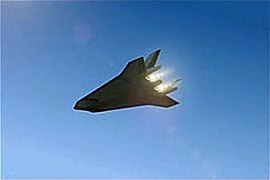
The HTV-3X activates its turbojets in transonic flight...
-
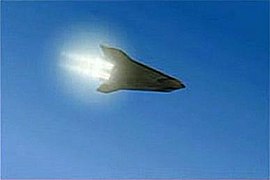
...then ignites its scramjets for the hypersonic stage
Flight testing [edit]
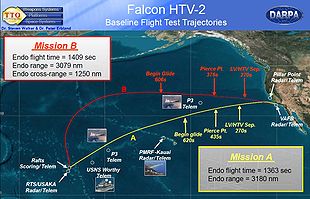
Flight Examination trajectories for HTV 2a and 2b
DARPA had two HTV-2s congenital for two flying tests in 2010 and 2011. The Minotaur Iv light rocket is the booster for the HTV-2 with Vandenberg Space Force Base (known as Vandenberg Air Force Base of operations from 1957-2021[24])serving as the launch site. DARPA planned the flights to demonstrate thermal protection systems and aerodynamic command features.[three] [15] Test flights were supported by NASA, the Infinite and Missile Systems Center, Lockheed Martin, Sandia National Laboratories and the Air Force Research Laboratory's (AFRL) Air Vehicles and Space Vehicles Directorates.
The beginning HTV-2 flight was launched on 22 April 2010.[15] The HTV-2 glider was to fly 4,800 miles (7,700 km) across the Pacific to Kwajalein at Mach 20.[22] The launch was successful, but the first mission was not completed as planned. Reports stated that contact had been lost with the vehicle 9 minutes into the mission.[25] [26] In mid-November, DARPA revealed that the examination flight had ended when the estimator autopilot had "commanded flying termination". According to a DARPA spokesman, "When the onboard system detects [undesirable or unsafe flying] behavior, it forces itself into a controlled roll and pitchover to descend straight into the ocean." Reviews found that the craft had begun to roll violently.[27]
A second flying was launched on xi August 2011. The unmanned Falcon HTV-2 successfully separated from the booster and entered the mission's glide phase, but over again lost contact with control about nine minutes into its planned 30-minute Mach 20[ citation needed ] glide flying. Initial reports indicated information technology purposely impacted the Pacific Bounding main along its planned flying path as a safety precaution.[28] [29] [xxx] Some analysts thought that the second failure would outcome in an overhaul of the Falcon plan.[31]
Refocus [edit]
In July 2013, DARPA decided it would not comport a third flight test of the HTV-2 because enough data had been collected from the first two flights, and another test was not idea to provide whatsoever more than usable data for the price. The tests provided data on flight aerodynamics and high-temperature effects on the aeroshell. Work on the HTV-2 would continue to summertime 2014 to provide more written report on hypersonic flying. The HTV-two was the last agile office of the Falcon program. DARPA has now changed its focus for the program from global/strategic strike to high-speed tactical deployment to penetrate air defenses and hitting targets quickly from a safe distance.[32]
See likewise [edit]
- Boeing X-51
- Prompt Global Strike, a follow-on military project
- Rockwell X-30 (National AeroSpace Plane)
- Lockheed Martin SR-72
- Boost-glide
References [edit]
- ^ "Usa looks for answers afterward hypersonic aeroplane fails". Infinite-travel.com . Retrieved 24 April 2018.
- ^ a b FALCON Strength Application and Launch from CONUS Wide Agency Announcement (BAA) Phase I Proposer Information Pamphlet (PIP) for BAA Solicitation 03-35 Archived 2008-11-27 at the Wayback Machine. DARPA, 2003.
- ^ a b c "Falcon Applied science Sit-in Program HTV-3X Blackswift Exam Bed" Archived 2010-12-20 at the Wayback Machine. DARPA, Oct 2008.
- ^ "Falcon HTV-2". Defence ADVANCED RESEARCH PROJECTS Agency. Retrieved 19 September 2021.
- ^ "Superfast Armed forces Aircraft Hit Mach 20 Earlier Ocean Crash, DARPA Says". space.com. 18 Baronial 2011. Retrieved xix September 2021.
- ^ Isinglass Archived 2006-06-14 at the Wayback Machine. astronautix.com
- ^ Cooper Testimony Archived 2007-07-29 at the Wayback Machine. tgv-rockets.com
- ^ Infinite Weapons Spending in the FY 2008 Defense Budget Archived 2007-03-13 at the Wayback Car. cdi.org
- ^ "Internal Communications: 10-12-01-hypersoar.HTML". Archived from the original on 2013-03-03. Retrieved 2016-01-21 .
- ^ "X-41 CAV". Designation-systems.net . Retrieved 24 Apr 2018.
- ^ a b c USAF DARPA FALCON Program Archived 2008-08-30 at the Wayback Auto. Air-attack.com. Retrieved: 2012-02-05.
- ^ ±±±±±±
- ^ "Falcon Technology Demonstration Plan: Fact Canvass" Archived 2016-12-21 at the Wayback Motorcar. DARPA, January 2006.
- ^ "Us hypersonic aircraft projects face up change as Congress urges articulation technology role" Archived 2008-09-06 at the Wayback Machine. Flying International, 30 May 2006.
- ^ a b c "First Minotaur 4 Low-cal launches from Vandenberg" Archived April 26, 2010, at the Wayback Machine. U.S. Air Force, 22 April 2010.
- ^ "U.s. hypersonic glider flunks first exam flying" Archived 2012-12-15 at the Wayback Machine. AFP news agency, 27 March 2010.
- ^ Graham Warwick (24 April 2010). "DARPA's HTV-2 Didn't Phone Home". Aviation Week. Archived from the original on 17 November 2011. Retrieved 2012-02-05 .
- ^ "Propulsion, Materials Test Successes Put Positive Spin on Falcon Prospects" [ permanent dead link ] . Aviation Week, 22 July 2007.
- ^ Falcon HTV-ii Archived September 4, 2011, at the Wayback Machine. DARPA
- ^ Warwick, Graham (24 July 2008). "Boeing Joins Lockheed Martin On Blackswift" Archived 2012-04-18 at the Wayback Automobile. Aviation Week, 24 July 2008. Retrieved: 28 March 2010.
- ^ Lorenz III, Philip (17 May 2007). "DARPA official: AEDC 'critical' to hypersonics advancement". Arnold Air Force Base. Archived from the original on 15 April 2010. Retrieved 28 March 2010.
- ^ a b Little, Geoffrey. "Mach 20 or Bust, Weapons research may yet produce a true spaceplane" Archived 2013-01-01 at annal.today. Air & Infinite Mag, 1 September 2007.
- ^ Trimble, Stephen. "DARPA cancels Blackswift hypersonic test bed" Archived 2011-05-20 at the Wayback Car. Flight Global, 13 October 2008. Retrieved 28 March 2010.
- ^ "Vandenberg Air Force Base". Armed forces Bases. 2012-11-30. Archived from the original on 2014-x-x.
- ^ Clark, Stephen. "New Minotaur rocket launches on suborbital flying" Archived 2010-04-25 at the Wayback Machine. spaceflightnow.com, 23 April 2010.
- ^ Waterman, Shaun. "Aeroplane's flameout may end space weapon programme" Archived 2012-x-19 at the Wayback Car. The Washington Times, 22 July 2010.
- ^ Waterman, Shaun (25 November 2010). "Pentagon to test 2nd most-space strike craft". The Washington Times. Archived from the original on 29 Nov 2010. Retrieved November 30, 2010.
- ^ Rosenberg, Zach. "DARPA loses contact with HTV-ii" Archived 2011-12-30 at the Wayback Car. Flight International, eleven August 2011.
- ^ "DARPA HYPERSONIC VEHICLE ADVANCES TECHNICAL KNOWLEDGE" Archived 2014-04-06 at the Wayback Machine. DARPA, 11 Baronial 2011.
- ^ Norris, Guy. "Review Board Sets Upward to Probe HTV-two Loss" Archived 2011-11-21 at the Wayback Machine. Aviation Week, 12 August 2011.
- ^ "Hypersonic test shipping 'lost'". BBC News. 12 August 2011. Archived from the original on 2011-08-12. Retrieved 2011-08-12 . . BBC NEWS, eleven August 2011.
- ^ Darpa Refocuses Hypersonics Inquiry On Tactical Missions Archived 2014-01-17 at the Wayback Motorcar - Aviationweek.com, 8 July 2013
External links [edit]
- Falcon page on Darpa.mil
- HCV folio on Globalsecurity.org
- "Air Drops Dummy Rocket for Darpa's Falcon", Aviation Week,
- "Hypersonics Dorsum in the News" on Defensetech.org
- "Going Hypersonic: Flying FALCON for Defense" and "Air Strength Plans Flight Tests Of Hypersonic Vehicle" on Space.com
- "Pentagon Has Far-Reaching Defence force Spacecraft in Works" [ dead link ] , Washington Mail, March 16, 2005
- "The states hypersonic shipping projects face change as Congress urges joint engineering office", Flight International, 30 May 2006

3x 18 What Is X,
Source: https://en.wikipedia.org/wiki/DARPA_Falcon_Project
Posted by: pucciospirly98.blogspot.com
0 Response to "3x 18 What Is X"
Post a Comment